
Market Size and Forecast 2032
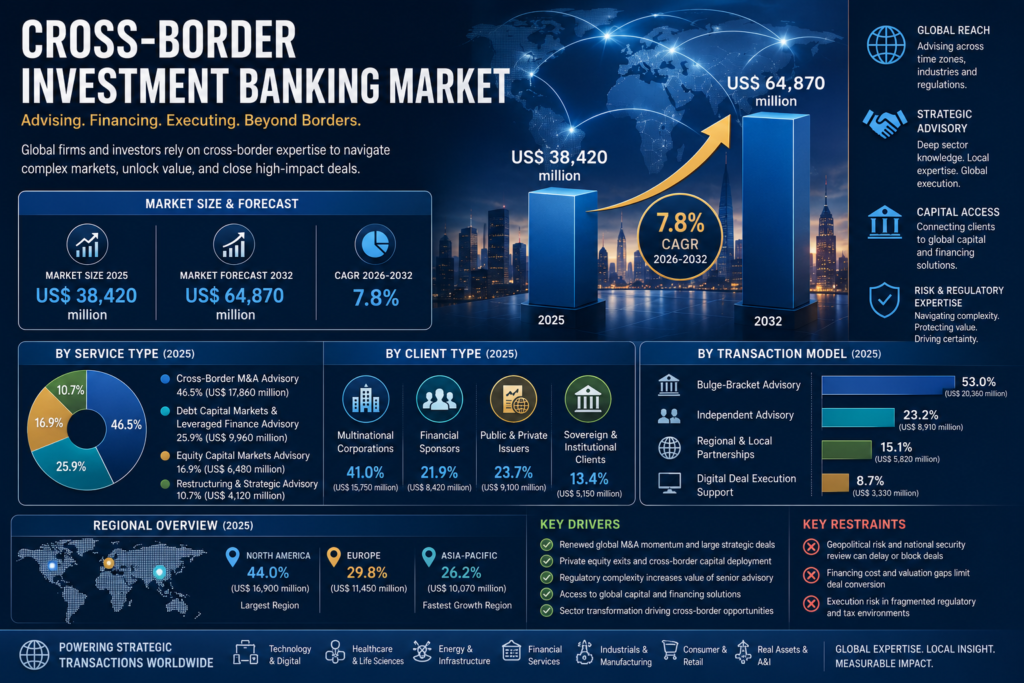
The Cross-Border Investment Banking Market refers to the advisory, structuring, underwriting, financing, and execution services that support transactions involving buyers, sellers, issuers, investors, or assets located in more than one jurisdiction. The market includes cross-border mergers and acquisitions, international equity and debt issuance, acquisition financing, leveraged finance, restructuring advisory, fairness opinions, regulatory transaction support, private capital raising, and strategic advisory for multinational corporate activity. It excludes purely domestic investment banking mandates, retail brokerage, wealth management, conventional corporate lending without transaction advisory, and asset management activities that are not directly linked to cross-border capital formation or deal execution.The global Cross-Border Investment Banking Market was valued at US$ 38,420 million in 2025 and is projected to reach US$ 64,870 million by 2032, registering a modeled CAGR of 7.8% during 2026-2032.
The market is expanding because multinational companies, financial sponsors, sovereign investors, infrastructure platforms, and technology-led acquirers are again using international transactions to reposition portfolios, access new markets, secure supply chains, and acquire strategic capabilities. After a subdued transaction cycle in 2022-2024, 2025 marked a stronger recovery in global deal activity, supported by larger transactions, improved financing visibility, and a more active capital markets environment. Recent market commentary also points to a broader recovery in M&A and capital markets activity moving into 2026, although the recovery remains more selective than the liquidity-driven cycle of 2021.
Commercially, cross-border investment banking matters because international transactions are more complex, higher-fee, and more advisory-intensive than domestic deals. A buyer acquiring a regulated asset in another country must manage currency exposure, merger control, tax leakage, foreign direct investment screening, financing certainty, minority shareholder protections, employee consultation, post-merger integration, and public-market communication. These requirements increase the value of banks with strong sector coverage, local regulatory knowledge, financing balance sheets, and senior advisory relationships across multiple jurisdictions.
The market is being structurally reshaped by four forces. First, large strategic acquirers are using cross-border M&A to gain exposure to AI infrastructure, energy transition assets, healthcare platforms, advanced manufacturing, and financial services consolidation. Second, private equity firms are under pressure to exit assets and redeploy capital, which is supporting sponsor-led sell-side, buy-side, refinancing, and continuation-vehicle advisory. Third, governments are becoming more interventionist, particularly in sectors linked to national security, data, defense, critical minerals, semiconductors, energy infrastructure, and biotechnology. Fourth, clients increasingly expect investment banks to combine senior judgment with faster analytics, scenario modeling, valuation benchmarking, and digital transaction execution.
What is changing most clearly is the definition of execution quality. In the previous cycle, successful cross-border banking was often measured by access to capital and ability to secure high valuation multiples. In the 2026-2032 period, execution quality will be defined by regulatory sequencing, financing deliverability, shareholder narrative, tax-aware structure, geopolitical risk management, and post-deal value protection. This favors banks and advisory firms that can coordinate local market expertise with global sector knowledge, rather than firms that rely only on balance sheet strength or league-table visibility.
Market Scope
| Metric | Value |
| Market Size in 2025 | US$ 38,420 million |
| Market Size in 2032 | US$ 64,870 million |
| CAGR 2026-2032 | 7.8% |
| Largest Service Type in 2025 | Cross-Border M&A Advisory |
| Fastest-Growing Service Type | Restructuring and Strategic Advisory |
| Largest Client Type in 2025 | Multinational Corporations |
| Largest Transaction Model in 2025 | Bulge-Bracket Advisory |
| Largest Region in 2025 | North America |
| Fastest Strategic Growth Region | Asia-Pacific |
| Most Important Country Market | USA |
| Key Strategic Trend | Shift from transaction execution to regulatory, financing, and geopolitical deal architecture |
| Highest Strategic Priority Theme | Cross-border advisory capability linked with sector specialization and regulatory certainty |
Analyst View
The Cross-Border Investment Banking Market should be interpreted as a strategic advisory market, not only as a transaction-fee market. The strongest demand is no longer coming from opportunistic dealmaking alone. It is coming from companies and financial sponsors that need to reconfigure their geographic exposure, supply chains, technology capabilities, and capital structures in a more fragmented global economy. Cross-border banking demand is therefore becoming more closely tied to board-level portfolio strategy than to short-term acquisition appetite.The deeper commercial shift is that deal complexity is rising faster than deal volume. Foreign investment screening, antitrust review, sector-specific national security controls, sanctions exposure, local financing requirements, tax reform, and political scrutiny are adding more friction to international transactions. The EU has moved toward a more coordinated and mandatory FDI screening framework, while the U.S. outbound investment regime has introduced restrictions and notification requirements for sensitive technology investments involving countries of concern. These developments increase execution risk but also raise advisory value for banks that can help clients structure deals before regulatory problems become transaction blockers.
Commercial value is shifting toward advisory models that integrate M&A judgment, financing structure, regulatory strategy, and investor communication. Large banks remain advantaged in acquisition financing, global underwriting, and multi-product mandates. However, independent advisory firms are gaining relevance in contested transactions, board mandates, fairness opinions, carve-outs, and high-stakes strategic assignments where senior banker attention and perceived independence matter. As a result, the market is becoming semi-consolidated at the top but more specialized underneath.
Market Drivers
Renewed Global M&A Momentum and Larger Strategic Transactions
The strongest market driver is the return of large strategic transactions after the 2022-2024 slowdown. Companies are again using acquisitions to access technology, infrastructure, energy-transition platforms, healthcare capabilities, and new geographic revenue pools. Large transactions generate disproportionately high advisory fees because they require complex valuation work, financing coordination, regulatory filings, stakeholder communication, and integration planning. This directly supports cross-border M&A advisory revenue and increases demand for banks with global sector coverage.Private Equity Exit Pressure and Cross-Border Capital Deployment
Financial sponsors remain a major source of cross-border investment banking demand. Many funds accumulated mature assets during the slower exit environment and now need to monetize portfolios, refinance holdings, pursue continuation vehicles, or execute sponsor-to-sponsor transactions. At the same time, large pools of private capital are seeking international platforms in technology services, healthcare, infrastructure, energy, and industrials. This supports sell-side advisory, acquisition financing, leveraged finance, private placements, and secondary transaction advisory.Regulatory Complexity Is Increasing the Value of Senior Advisory
Cross-border transactions are becoming more difficult to complete without early-stage regulatory architecture. FDI screening, merger control, national security review, data localization, sanctions, export controls, and political review can alter valuation, financing terms, closing timelines, and buyer eligibility. This complexity is a growth driver for premium investment banking advisory because clients need practical guidance on deal sequencing, buyer universe selection, conditionality, jurisdictional risk, and stakeholder messaging. Stronger EU-level FDI screening coordination and U.S. outbound investment controls are examples of how regulation is becoming embedded into deal design rather than treated as a late-stage legal matter.Market Restraints
Geopolitical Risk and National Security Review Can Delay or Block Deals
The most important restraint is the rising probability that cross-border transactions face political or national security scrutiny. Deals involving semiconductors, AI, defense, critical infrastructure, energy, telecommunications, biotechnology, data assets, and critical minerals are increasingly reviewed through economic security frameworks. This can lengthen timelines, reduce bidder participation, lower valuation certainty, and force remedies such as divestitures, governance restrictions, local commitments, or transaction abandonment.Financing Cost and Valuation Gaps Still Limit Deal Conversion
Although financing markets improved in 2025, many cross-border transactions still face valuation gaps between sellers anchored to previous-cycle multiples and buyers underwriting higher capital costs, foreign exchange volatility, and regulatory risk. Acquisition financing has become more selective, especially for leveraged buyouts, emerging-market transactions, and sectors with uncertain cash-flow visibility. This limits conversion from pipeline to completed mandates and can shift revenue from success-fee-heavy M&A advisory into lower-fee preparatory work.Execution Risk Is Higher in Fragmented Regulatory and Tax Environments
Cross-border investment banking increasingly requires coordination across multiple tax systems, listing regimes, accounting standards, labor rules, shareholder approval requirements, and disclosure frameworks. Global minimum tax implementation, transfer pricing scrutiny, and local substance requirements can materially affect post-deal returns. For clients, this increases advisory dependence but can also slow mandate progression. For banks, it raises the cost of execution because more transactions require local counsel coordination, technical modeling, and multi-jurisdiction process management.Market Segmentation
By Service Type
Cross-Border M&A Advisory generated US$ 17,860 million in 2025, representing 46.5% of total market revenue, and is projected to reach US$ 30,120 million by 2032. This segment leads because M&A remains the highest-value cross-border investment banking activity and commands premium fees when transactions involve public companies, regulated assets, competing bidders, financing packages, or complex shareholder considerations. The segment benefits from renewed strategic deal activity, private equity exits, corporate carve-outs, and demand for cross-border capability acquisitions. Its growth is also supported by the fact that international M&A requires more advisory intensity than domestic transactions due to currency, tax, governance, political, and regulatory factors.Equity Capital Markets Advisory generated US$ 6,480 million in 2025, representing 16.9% of total market revenue, and is projected to reach US$ 10,740 million by 2032. This segment includes cross-border IPOs, follow-on offerings, block trades, rights issues, depositary receipt offerings, convertible issuance, and equity-linked capital raising. The segment is strategically important because international issuers increasingly seek access to deeper pools of institutional capital, while public-market investors are showing renewed interest in profitable technology, infrastructure, healthcare, financial services, and energy-transition platforms. Cross-border ECM activity remains sensitive to market volatility, but advisory value improves when issuers need listing venue analysis, valuation positioning, cornerstone investor targeting, and regulatory disclosure support.
Debt Capital Markets and Leveraged Finance Advisory generated US$ 9,960 million in 2025, representing 25.9% of total market revenue, and is projected to reach US$ 15,820 million by 2032. This segment includes acquisition financing, bridge financing, investment-grade bond issuance, high-yield debt, syndicated loans, cross-border refinancing, and liability management. It remains large because many international transactions depend on financing certainty, especially in sponsor-led acquisitions and capital-intensive sectors. The segment is also supported by refinancing needs as companies manage maturity walls, currency exposure, and interest-rate normalization. Banks with strong balance sheets, distribution networks, and credit structuring capabilities are advantaged in this category.
Restructuring and Strategic Advisory generated US$ 4,120 million in 2025, representing 10.7% of total market revenue, and is projected to reach US$ 8,190 million by 2032, making it the fastest-growing service type. This segment includes cross-border restructuring, distressed M&A, liability management, sovereign-linked advisory, capital structure review, and special situations advisory. Growth is being driven by refinancing stress, higher real borrowing costs, weak demand in selected industrial sectors, and complex multinational balance sheets. The segment is attractive because distressed and restructuring mandates are less dependent on bullish M&A sentiment and often require senior, technical, and jurisdiction-specific expertise.
By Client Type
Multinational Corporations generated US$ 15,750 million in 2025, representing 41.0% of total market revenue, and are projected to reach US$ 26,820 million by 2032. This client group leads because large corporates use cross-border advisory for acquisitions, divestitures, joint ventures, carve-outs, public-market financing, and strategic portfolio repositioning. Demand is strongest in technology, healthcare, energy, financial services, industrials, infrastructure, and consumer platforms with international supply chains. Multinational clients typically require banks that can coordinate sector analysis, local buyer intelligence, financing, regulatory strategy, and board-level communication.Financial Sponsors generated US$ 8,420 million in 2025, representing 21.9% of total market revenue, and are projected to reach US$ 15,430 million by 2032. This segment is growing because private equity firms, infrastructure funds, sovereign-backed investment platforms, and credit funds are increasing cross-border deal activity to deploy capital and realize mature investments. Sponsors use investment banks for sell-side auctions, buy-side origination, acquisition financing, continuation funds, minority recapitalizations, and portfolio-level strategic reviews. The segment’s attractiveness comes from repeat-client relationships, high transaction frequency, and the need for coordinated financing and exit planning.
Public and Private Issuers generated US$ 9,100 million in 2025, representing 23.7% of total market revenue, and are projected to reach US$ 14,570 million by 2032. This segment includes companies raising capital outside their home market through equity, debt, convertible, or private placement structures. Issuers turn to cross-border investment banks when local markets cannot provide sufficient valuation depth, currency alignment, institutional demand, or tenor. The segment is particularly relevant for technology, infrastructure, renewable energy, financial institutions, and growth companies seeking broader investor access.
Sovereign and Institutional Clients generated US$ 5,150 million in 2025, representing 13.4% of total market revenue, and are projected to reach US$ 8,050 million by 2032. This group includes sovereign wealth funds, pension funds, development finance institutions, state-owned enterprises, and large institutional investors pursuing international acquisitions, divestitures, privatizations, infrastructure investments, and strategic partnerships. Demand is shaped by energy security, industrial policy, infrastructure modernization, and portfolio diversification. These clients often require long-horizon advisory, political sensitivity, and complex stakeholder management, which raises the value of senior relationship-led banking.
By Transaction Model
Bulge-Bracket Advisory generated US$ 20,360 million in 2025, representing 53.0% of total market revenue, and is projected to reach US$ 33,640 million by 2032. This model leads because large global banks combine advisory, financing, underwriting, market intelligence, and distribution capabilities across regions. They are particularly strong in large-cap M&A, acquisition financing, cross-border IPOs, bond issuance, and multi-product strategic mandates. Their competitive advantage comes from balance sheet capacity, global coverage networks, institutional investor access, and the ability to support clients across advisory and capital markets.Independent Advisory generated US$ 8,910 million in 2025, representing 23.2% of total market revenue, and is projected to reach US$ 16,070 million by 2032. This model is gaining share because boards often prefer independent advice in complex, contested, or high-profile transactions. Independent firms are especially relevant in public M&A, fairness opinions, restructuring, shareholder defense, carve-outs, and special committee assignments. The segment is growing faster than the market average because senior banker access, conflict-light positioning, and sector specialization are becoming more valuable in complex cross-border situations.
Regional and Local Advisory Partnerships generated US$ 5,820 million in 2025, representing 15.1% of total market revenue, and are projected to reach US$ 8,930 million by 2032. This segment includes local investment banks, boutique advisory firms, and regional partners that support global banks or independent advisors in market-entry deals, mid-market transactions, regulatory navigation, and buyer identification. The segment remains important because cross-border execution often depends on local language capability, political understanding, private-company access, and regulatory familiarity. However, growth is slower than independent advisory because large clients increasingly seek globally coordinated coverage.
Digital Deal Execution Support generated US$ 3,330 million in 2025, representing 8.7% of total market revenue, and is projected to reach US$ 6,230 million by 2032. This segment includes analytics platforms, virtual data room support, AI-enabled screening, valuation automation, due diligence workflow tools, investor targeting systems, and transaction process management. It is not replacing senior advisory, but it is becoming embedded into deal execution. Growth is strong because clients expect faster screening, more precise buyer mapping, improved diligence coordination, and better scenario modeling across jurisdictions.
Regional Analysis
North America Cross-Border Investment Banking Market
North America generated US$ 16,900 million in 2025, representing 44.0% of global market revenue, and is projected to reach US$ 26,540 million by 2032. The region leads because it has the deepest capital markets, the largest pool of strategic acquirers, the most active private equity ecosystem, and the strongest concentration of global investment banking headquarters. North America also benefits from substantial technology, healthcare, financial services, infrastructure, and energy transaction activity, all of which are sectors with high cross-border advisory intensity.The region’s strength is reinforced by its role as both a buyer and seller market. U.S.-based companies frequently acquire international assets to access growth, technology, supply-chain resilience, or regulated-market positions. At the same time, foreign buyers continue to target U.S. assets because of market scale, innovation depth, and dollar-denominated capital access. Regulatory review remains a major consideration, particularly for sensitive technology, data, energy, defense, and infrastructure assets. The U.S. outbound investment program and national security review environment have made early transaction structuring more important for international mandates.
USA Cross-Border Investment Banking Market
The USA generated US$ 14,280 million in 2025 and is projected to reach US$ 22,100 million by 2032. It is the single most important country market because U.S. banks dominate global investment banking fee pools, U.S. corporates remain among the most active outbound acquirers, and U.S. public markets remain central to international equity and debt issuance. The country’s advisory demand is strongest in technology, AI infrastructure, healthcare, energy, financial services, industrial technology, and private equity exits.The U.S. market is also becoming more complex. Cross-border transactions involving sensitive technologies, China-linked exposure, data assets, critical infrastructure, and national security sectors face greater regulatory review. This increases the importance of regulatory sequencing, political risk analysis, and transaction structure before a formal process begins. For investment banks, the U.S. remains the highest-value fee pool, but also one of the most demanding markets in terms of execution discipline.
Europe Cross-Border Investment Banking Market
Europe generated US$ 11,450 million in 2025, representing 29.8% of global market revenue, and is projected to reach US$ 18,530 million by 2032. Europe is a structurally important cross-border market because the region combines mature public companies, family-owned industrial groups, private equity assets, financial services consolidation, energy transition infrastructure, and fragmented national markets. Cross-border activity is often intra-European, transatlantic, or linked to strategic Asian capital.European dealmaking is being reshaped by FDI screening, industrial policy, energy security, and stricter review of foreign ownership in sensitive sectors. EU institutions have advanced revisions to the FDI screening framework designed to strengthen the ability to identify and address risks from certain foreign investments while preserving openness to trade and investment. This does not eliminate deal activity, but it raises the value of early regulatory planning and local jurisdiction expertise.
Germany Cross-Border Investment Banking Market
Germany generated US$ 3,240 million in 2025 and is projected to reach US$ 5,230 million by 2032. Germany is a major market because of its advanced industrial base, engineering depth, automotive supply chain, chemical industry, renewable energy transition, and large privately owned Mittelstand companies. Cross-border advisory demand is strongest in industrial automation, mobility, energy infrastructure, defense-adjacent manufacturing, healthcare technology, and carve-outs from large industrial groups.German transactions often require careful handling of labor stakeholders, works councils, regulatory approvals, and long-term industrial strategy. Foreign buyers remain attracted to German technology and manufacturing assets, but political sensitivity around strategic industries has increased. This makes Germany a high-value advisory market where local credibility and sector expertise are especially important.
France Cross-Border Investment Banking Market
France generated US$ 2,180 million in 2025 and is projected to reach US$ 3,580 million by 2032. France is important because of its large listed companies, infrastructure assets, aerospace and defense exposure, luxury and consumer groups, energy companies, financial institutions, and active private equity ecosystem. Cross-border banking demand is supported by divestitures, public-market transactions, infrastructure rotation, and strategic acquisitions across Europe and North America.The French market is also highly sensitive to national interest considerations. Transactions involving defense, energy, critical technologies, transport infrastructure, and data-linked assets can attract political attention. Banks with strong Paris coverage, EU regulatory coordination, and public-company advisory capabilities are well positioned in this market.
Asia-Pacific Cross-Border Investment Banking Market
Asia-Pacific generated US$ 10,070 million in 2025, representing 26.2% of global market revenue, and is projected to reach US$ 19,800 million by 2032, making it the fastest strategic growth region. The region is expanding because outbound investment from Japan, South Korea, Singapore, India, Australia, and selected Southeast Asian markets is increasing, while international investors continue to target technology, manufacturing, consumer, logistics, energy, and healthcare assets across Asia.Asia-Pacific’s growth is shaped by uneven market maturity. Japan and South Korea are active outbound acquirer markets. China remains significant but more constrained by geopolitical review, capital controls, and foreign investor caution. Southeast Asia is becoming more relevant for infrastructure, digital platforms, consumer growth, and supply-chain relocation. For investment banks, the region requires a mix of local regulatory understanding, family-owner access, sponsor relationships, and international financing capability.
Japan Cross-Border Investment Banking Market
Japan generated US$ 2,750 million in 2025 and is projected to reach US$ 4,910 million by 2032. Japan is one of the strongest Asia-Pacific markets for outbound M&A because Japanese companies continue to seek overseas growth in healthcare, industrial technology, software, financial services, consumer brands, and infrastructure. Domestic demographic pressure and limited home-market growth make international acquisitions strategically important for many large Japanese corporates.Japan’s policy environment is also changing. The country has been considering a more centralized foreign investment screening approach modeled partly on the U.S. system, reflecting greater focus on economic security and strategic technology protection. This could improve process clarity for low-risk transactions but may increase review intensity for sensitive sectors.
China Cross-Border Investment Banking Market
China generated US$ 3,210 million in 2025 and is projected to reach US$ 6,280 million by 2032. China remains a large cross-border investment banking market because of its manufacturing base, technology platforms, energy-transition supply chains, financial institutions, and international capital needs. However, the market is more selective than in the previous outbound M&A cycle. Political review, export controls, data security rules, and scrutiny of Chinese investment in strategic sectors have changed the transaction environment.Inbound and outbound transactions involving Chinese counterparties require greater attention to jurisdictional approval, sanctions exposure, beneficial ownership, financing flows, and technology-transfer risk. This creates strong demand for banks with deep regulatory experience, but also limits deal conversion in sensitive sectors.
South Korea Cross-Border Investment Banking Market
South Korea generated US$ 1,060 million in 2025 and is projected to reach US$ 2,090 million by 2032. South Korea is becoming more relevant because of its global leadership in semiconductors, batteries, shipbuilding, consumer electronics, entertainment, automotive supply chains, and industrial technology. Korean conglomerates and financial sponsors continue to pursue international acquisitions and partnerships to secure technology, market access, and supply-chain resilience.Cross-border advisory demand is strongest in battery materials, semiconductor equipment, clean energy, automotive technology, and consumer platforms. Banks that can bridge Korean corporate decision-making with U.S. and European target markets are particularly well positioned.
Competitive Analysis
The Cross-Border Investment Banking Market is semi-consolidated at the top and fragmented beneath the global leaders. Large international banks dominate the highest-value mandates because they combine global sector coverage, financing capacity, underwriting capability, institutional investor distribution, and senior board relationships. These firms are most competitive in large-cap M&A, acquisition finance, cross-border IPOs, debt issuance, and multi-jurisdiction strategic assignments.Independent advisory firms compete strongly in areas where clients prioritize senior attention, independence, discretion, and complex judgment. Their position is strongest in public M&A, defense mandates, special committees, fairness opinions, restructuring, and strategic alternatives reviews. The acquisition of specialist advisory platforms by larger firms shows that senior advisory talent and local market credibility remain strategic assets in cross-border banking.
Competition is increasingly defined by sector specialization, regulatory intelligence, financing certainty, and execution credibility. Banks are not only competing on relationships or fees. They are competing on the ability to identify viable buyers, structure deals around regulatory obstacles, secure committed financing, manage shareholder narratives, and close transactions in volatile markets. Digital tools are improving process speed, but the premium fee pool remains concentrated around judgment-intensive advisory.
Key Companies
JPMorgan Chase
JPMorgan Chase is one of the strongest global players in cross-border investment banking because of its scale across M&A advisory, debt capital markets, equity capital markets, leveraged finance, payments, markets, and corporate banking. Its global client franchise allows it to support multinational corporates and financial sponsors across acquisition financing, public-market issuance, and strategic transaction execution. The firm’s advisory strength is reinforced by its balance sheet, sector coverage depth, and ability to coordinate complex financing packages for international transactions.The bank remains strategically focused on global M&A momentum, sector-led advisory, and integrated client coverage. Its public M&A outlook for 2026 emphasizes key transaction drivers, sector momentum, and the return of deal activity, which aligns with the broader recovery in cross-border strategic mandates.
Goldman Sachs
Goldman Sachs is a leading cross-border investment banking franchise with strong positions in strategic advisory, M&A, equity underwriting, debt underwriting, private capital, and financing solutions. The firm is especially strong in board-level advisory, technology, financial sponsors, healthcare, industrials, energy, and complex public-market transactions. Its competitive position is based on senior relationship depth, institutional investor access, and high-value advisory mandates.Goldman Sachs reported continued gains in Global Banking and Markets wallet share in its 2025 annual report and highlighted stronger client standing across its largest relationships. The firm’s financing businesses also reached record levels in 2025, which is strategically relevant because cross-border transactions increasingly require flexible capital solutions alongside advisory.
Morgan Stanley
Morgan Stanley is an important competitor in the Cross-Border Investment Banking Market because of its strength in M&A advisory, equity capital markets, sponsor coverage, wealth-linked distribution, and strategic sector advisory. The firm has a strong position in technology, financial services, consumer, healthcare, infrastructure, and private equity-linked transactions. Its cross-border relevance is supported by its ability to advise large corporate clients while also supporting capital markets execution.The firm’s 2026 M&A outlook identifies AI infrastructure, financial sponsor activity, and cross-border deals as key forces supporting another active year for dealmaking. This positioning is commercially meaningful because Morgan Stanley is well placed in the sectors where cross-border strategic transactions are most likely to remain active.
Citi
Citi is highly relevant in cross-border investment banking because of its global network, corporate banking relationships, treasury services, transaction banking connectivity, and presence across emerging and developed markets. Its competitive advantage is strongest where clients need advisory capability combined with local-market access, currency expertise, financing support, and international operating knowledge. Citi is particularly important for multinational clients with complex geographic exposure.Citi reported a record year for Banking in 2025, with revenue rising 32%, and stated that it participated in 15 of the year’s 25 largest investment banking transactions. The firm also described 2025 as the best year for M&A revenue in its history, indicating stronger relevance in large cross-border and strategic mandates.
Evercore
Evercore is one of the most important independent advisory firms in the cross-border investment banking market. Its business is centered on strategic advisory, M&A, restructuring, shareholder advisory, and capital advisory rather than balance-sheet lending. This gives it a strong position in board-level and conflict-sensitive mandates where clients value independent advice, senior banker access, and complex transaction judgment.Evercore’s acquisition of Robey Warshaw strengthened its European advisory platform and expanded its presence in high-value UK and EMEA mandates. The transaction was valued at US$ 196 million and was positioned as a way to expand global client reach and accelerate the firm’s European growth strategy.
Key Developments
- In April 2026, Goldman Sachs reported a sharp year-over-year increase in investment banking fees for the first quarter of 2026, with reported fees reaching US$ 2,840 million. This matters because it signals that large global banks are benefiting from stronger M&A completion activity and improved equity capital markets conditions, both of which support cross-border advisory revenue.
- In April 2026, Evercore reported that its M&A advisory fees rose strongly in the first quarter of 2026, reaching about US$ 1,200 million compared with US$ 557 million in the prior-year period. This is significant because independent advisory firms are capturing a larger share of complex strategic mandates as dealmaking improves.
- In April 2026, PJT Partners reported a 29.0% increase in first-quarter revenue to US$ 418.2 million, supported by stronger M&A activity and continued demand for advisory and restructuring expertise. This matters because it confirms that independent and specialist advisory platforms are benefiting from the same recovery that is supporting large global banks.
- In February 2026, EU institutions updated the provisional agreement related to revisions of the FDI screening regulation. The updated framework is designed to improve the EU’s ability to identify, assess, and address risks from certain foreign investments while maintaining openness to investment. This matters because FDI screening is now a central factor in cross-border deal planning, especially for sensitive sectors.
- In December 2025, new U.S. policy and legislative updates affected cross-border investment review, including developments linked to outbound investment controls and biotechnology-related restrictions. This matters because U.S. outbound investment rules and sensitive-sector restrictions are changing how banks and clients assess transaction feasibility, buyer eligibility, and regulatory risk in cross-border mandates.
Conclusion
The Cross-Border Investment Banking Market is positioned for steady expansion through 2032, but growth will be more disciplined than the liquidity-driven cycle seen earlier in the decade. The strongest value pools will emerge in large-cap M&A advisory, sponsor exits, acquisition financing, restructuring, strategic carve-outs, and capital markets transactions linked to technology, energy transition, healthcare, financial services, infrastructure, and advanced manufacturing. Transaction volume may remain uneven, but advisory intensity per transaction is likely to increase.The next phase of growth will be led by banks and advisory firms that can combine global reach with local execution credibility. Clients will increasingly select advisors based on sector knowledge, regulatory foresight, financing deliverability, investor access, and ability to protect value through closing. Banks with strong balance sheets will remain advantaged in financed transactions, while independent advisors will continue gaining share in complex, sensitive, or board-led situations.
By 2032, the market is expected to be more specialized, more regulated, and more analytics-enabled. Cross-border investment banking will remain a relationship-driven business, but winning firms will use data, AI-enabled screening, valuation analytics, and digital diligence tools to improve execution speed and decision quality. The companies best positioned to win will be those that treat cross-border transactions not as isolated deals, but as strategic capital allocation decisions shaped by geopolitics, regulation, financing markets, and long-term portfolio transformation.